Indian+fsi+sex+blog+__top__ Free
v4.2 designed by Peter JAKAB in 2004-2005
old version in December, 1999
NOTE for beginners: PICs
are general
purpose microcontrollers which have to be programmed before you
can use them in the actual circuit! Check out
this
link to learn
more.
Indian+fsi+sex+blog+__top__ Free
Here’s a solid, original piece centered on relationships and romantic storylines — a short but complete narrative that captures emotional depth, conflict, and resolution.
A job offer across the country. A fear of flying. A secret bank account. A text sent to the wrong person. The moment one person says, “I can’t,” and the other whispers, “Then let me carry it for a while.” Romantic storylines aren’t about flawless people—they’re about flawed people choosing each other anyway. indian+fsi+sex+blog+free
The Art of Heart: Crafting Relationships & Romantic Storylines That Resonate
Romance is the oldest genre in the book—literally. But in an era of cynical subversions and "situationships," writing a love story that feels both fresh and authentic is a challenge. A great romantic storyline isn't about two people simply ending up together; it’s about transformation. Here’s a solid, original piece centered on relationships
- Chemistry (Not just "Heat"): Chemistry is the magnetic reason two people orbit each other. It can be intellectual (debating philosophy), emotional (shared trauma), or playful (banter). Rule: If you remove the physical descriptions, does the conversation still sizzle?
- Stakes: What happens if they don't get together? Loneliness? Political ruin? Missed opportunity? The stakes must be personal to the characters, not just the plot.
- Verisimilitude (The "Why Them?" factor): In a world of 8 billion people, why do these two specifically work? They must challenge each other's flaws, not just mirror their virtues.
Whether you are a writer looking to craft a compelling "slow burn" or a reader curious about why certain tropes pull at your heartstrings, understanding the mechanics of romantic narratives is key. The Foundation: Why We Crave Romantic Narratives Chemistry (Not just "Heat"): Chemistry is the magnetic
We’ve all grown up on a steady diet of romantic storylines where the music swells, the rain pours, and two people realize they are "the one" just before the credits roll. But as anyone who has navigated a real-life relationship knows, the "happily ever after" is usually where the actual story begins.
Why Your ‘Love Story’ Could Make or Break Your Relationship - Verily
Don't rush the "big" moments. Embrace the quiet times where no words are needed, only the comfort of being near. 2. Ditching the "Sacrifice" Myth
Control
up
to 8 devices
by this easy constructable remote
control. It can work as a radio or infrared remote control, depending
on the components. Each device output can be configured to be momentary
(turned on while you press the button) or latched.
Latched outputs can be toggled on/off by one button per channel, or
turned on and off by two buttons per channel.

Try it now, before building! Click on the transmitter buttons with the
green
labels
on the left and see how the receiver outputs (K1-K8) change. Change
the number of transmitter or receiver channels. Switch the receiver
output type between latched and momentary.
Containing a PIC microcontroller, the circuit is very flexible. You can
decide which receiver outputs are latched and which are momentary. The
Manchester-coded transmitter output is well suited for the cheapest ASK
radio modules or for infrared control. The units are configurable to a
unique address, which must match to control the devices.
Related project: Learning
remote control receiver
Take your existing remote control and control everything with it. This
receiver can learn codes from an
RC-5 format IR remote control, and associate the buttons to different
channels and actions.
Related project: 2^16 remote control encoder
and
decoder
If you have TTL signals to control remote digital output lines, please
check this project
instead.
If you have trouble with programming PIC microcontrollers, you can
consider builing other circuits based on Holtek HT-12D, HT-12E,
Princeton PT2262, PT2272
and Motorola MC145026, MC145027, MC145028 encoders/decoders.
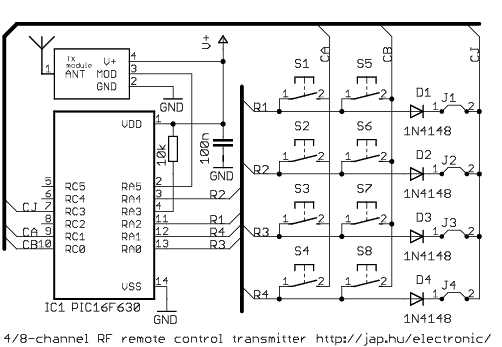
4/8-channel V4.2 radio transmitter
The
difference between the 4-channel and the 8-channel version is only the
software inside. The 8-channel transmitter has one button (S1-S8) per
channel.
The 4-channel transmitter uses S1-S4 buttons to turn on, S5-S8 buttons
to
turn off channel 1-4 (use with latched outputs on the receiver).
The D1-D4 diodes and J1-J4 jumpers are optional,
and are used to setup the transmitter address.
Higher supply voltage
results higher transmit power, but V+ range is
2-5.5VDC for the PIC MCU. When V+ is higher than 5VDC, use separate
power
for the mcu.
Configure & download
What if you can't get a pic16f630?
parts list
| part |
description |
C1
|
100nF ceramic capacitor |
R1
|
10k resistor (1/8W)
|
| D1-D4 |
1N4148 diode (optional)
|
S1-S8
|
tact switch, DTSM 61N or similar
|
| IC1 |
PIC16F630 or PIC16F676 microcontroller, pre-programmed
|
TXMOD
|
radio
transmitter module, see text (hardware)
|
B1
|
battery between 2-5.5VDC (check TXMOD specs for valid voltage range)
|
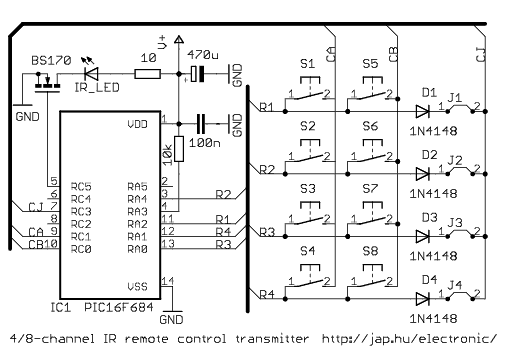
4/8-channel V4.2 infrared transmitter
The
difference between the 4-channel and the 8-channel version is only the
software inside. The 8-channel transmitter has one button (S1-S8) per
channel.
The 4-channel transmitter uses S1-S4 buttons to turn on, S5-S8 buttons
to
turn off channel 1-4 (use with latched outputs on the receiver).
The D1-D4 diodes and J1-J4 jumpers are optional,
and are used to setup the transmitter address.
V+ supply voltage should be between 2.5-5.5VDC.
It is practical to use two or three AAA batteries.
Configure & download
parts list
| part |
description |
C1
|
100nF ceramic capacitor |
C2
|
470 uF 6.3V, electrolytic
capacitor
|
R1
|
10k resistor (1/8W)
|
R2
|
10 ohm resistor (1/4W)
|
| D1-D4 |
1N4148 diode (optional)
|
D5
|
IR transmitter LED
|
Q1
|
BSS138 or similar N-MOSFET
|
S1-S8
|
tact switch, DTSM 61N or similar
|
| IC1 |
PIC16F684 microcontroller, pre-programmed
|
B1
|
battery between 2-5.5VDC (CR2032, 3.6V LiIon battery or 3xAA
batteries)
|
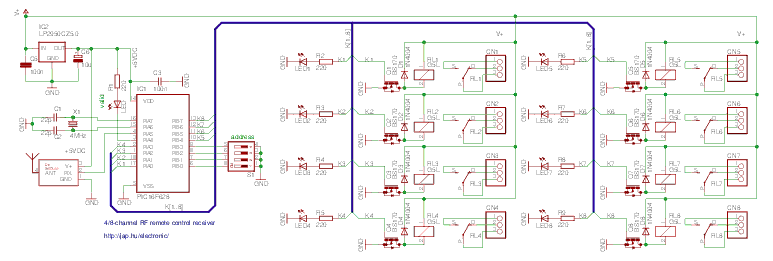
4/8-channel V4.2 radio receiver
component pinouts
parts list
| part |
description |
| C1, C2 |
22pF ceramic capacitor |
| C3, C5 |
100nF ceramic capacitor |
| C6 |
10uF 6.3V electrolytic capacitor |
| CN1-CN8 |
PCB terminal block, 3-way (DG301) |
| D1-D8 |
1N4004 diode |
| IC1 |
PIC16F627 or PIC16F628 or
PIC16F627A or PIC16F628A microcontroller, pre-programmed
|
| IC2 |
LP2950CZ5.0 voltage regulator |
| LED |
3mm LED (green) |
| LED1-LED8 |
3mm LED (red) |
| Q1-Q8 |
BS170 N-channel mosfet transistor |
| R1-R9 |
220R resistor (1/8W) |
| RL1-RL8 |
G5LE relay, see text for coil voltage selection |
| S1 |
piano DIP switch, 4-way |
| X1 |
4MHz HC49 crystal |
| RXMOD |
3-pin radio
receiver module, see text (hardware) |
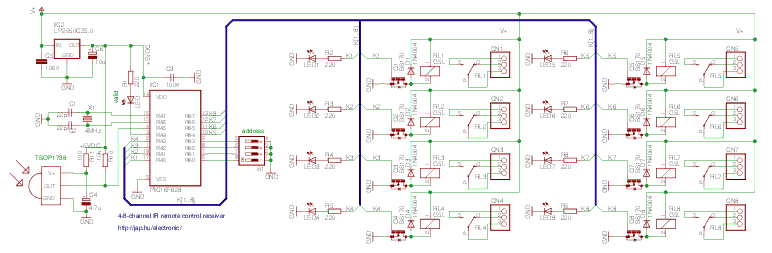
4/8-channel V4.2 infrared receiver
Here’s a solid, original piece centered on relationships and romantic storylines — a short but complete narrative that captures emotional depth, conflict, and resolution.
A job offer across the country. A fear of flying. A secret bank account. A text sent to the wrong person. The moment one person says, “I can’t,” and the other whispers, “Then let me carry it for a while.” Romantic storylines aren’t about flawless people—they’re about flawed people choosing each other anyway.
The Art of Heart: Crafting Relationships & Romantic Storylines That Resonate
Romance is the oldest genre in the book—literally. But in an era of cynical subversions and "situationships," writing a love story that feels both fresh and authentic is a challenge. A great romantic storyline isn't about two people simply ending up together; it’s about transformation.
- Chemistry (Not just "Heat"): Chemistry is the magnetic reason two people orbit each other. It can be intellectual (debating philosophy), emotional (shared trauma), or playful (banter). Rule: If you remove the physical descriptions, does the conversation still sizzle?
- Stakes: What happens if they don't get together? Loneliness? Political ruin? Missed opportunity? The stakes must be personal to the characters, not just the plot.
- Verisimilitude (The "Why Them?" factor): In a world of 8 billion people, why do these two specifically work? They must challenge each other's flaws, not just mirror their virtues.
Whether you are a writer looking to craft a compelling "slow burn" or a reader curious about why certain tropes pull at your heartstrings, understanding the mechanics of romantic narratives is key. The Foundation: Why We Crave Romantic Narratives
We’ve all grown up on a steady diet of romantic storylines where the music swells, the rain pours, and two people realize they are "the one" just before the credits roll. But as anyone who has navigated a real-life relationship knows, the "happily ever after" is usually where the actual story begins.
Why Your ‘Love Story’ Could Make or Break Your Relationship - Verily
Don't rush the "big" moments. Embrace the quiet times where no words are needed, only the comfort of being near. 2. Ditching the "Sacrifice" Myth
hardware
The radio version
circuit diagrams show generic ISM RF modules, which connect to
the circuits using two power pins and one modulation pin.
The transmitter (TX) module is connected to the transmitter circuit.
The receiver (RX) module is connected to the receiver circuit.
Choose ISM RF modules from the
list
of modules.
The remote control works with the cheapest OOK/ASK modules and with FSK
modules, too. Use the same frequency and modulation type for all
modules.
Choose a module which doesn't need setup - these are which connect only
using 3 pins
(ground (GND), power supply (VCC), modulation in/demod out (MOD) ) and
usually have an external antenna (ANT) connection.
If you are building the infrared version, choose an IR LED matching the
wavelength of the receiver module. The receiver
center frequency should match the transmitter modulation
frequency, which can be set the transmitter source (pwm_freq). If in
doubt, just choose a TSOP1738. A list of usable modules: Sharp
GP1U52X,
IS1U60L,
Vishay
TSOP17XX,
TSOP18XX.
FAQ
Q: Do I have to use a bs170 transistor in the receiver?
A: You can use other logic N-channel mosfets or npn bipolar
transistors (with a
series base resistor added) to drive the relays in place of Q1-Q8 of
the
remote control receiver. Examples: bss138, bc182+2.2kohm
Q: How do I set toggle or momentary mode for the relays?
A: Make a modification in the receiver source code. Modify the
LATCH_MASK define - this contains one bit for every channel.
A zero bit sets the corresponding output to momentary, a
high bit sets the corresponding output to latched. For example, the
line
LATCH_MASK EQU B'00001111' sets channels 8-5 to momentary
and
channels 4-1 to latched (toggle) mode. Then use the compiler (MPLAB or
gputils) to
assemble the code.
Q: I want to control multiple outputs by pressing button 2 and 3
at the same
time. Is that possible?
A: Not with this project. Please use this
2^16
remote control encoder and
decoder instead.
Q: What if I can't get a pic16f630?
A1: Try a pic16f676, and put this line back into code:
clrf
0x91 ;
ANSEL
A2: Try a pic16f628,
here is the
modified
transmitter
Q: What radio modules can this remote control work with?
A: You can choose from
this list. The
remote control works with the cheapest OOK/ASK modules and with FSK
modules, too. Use the same frequency and modulation type for all
modules.
Choose a module which doesn't need setup - these are which connect only
using 3 pins (ground (GND), power supply (VCC), modulation in/demod out
(MOD) ) and usually have an external antenna (ANT) connection.
 Peter's electronic projects